

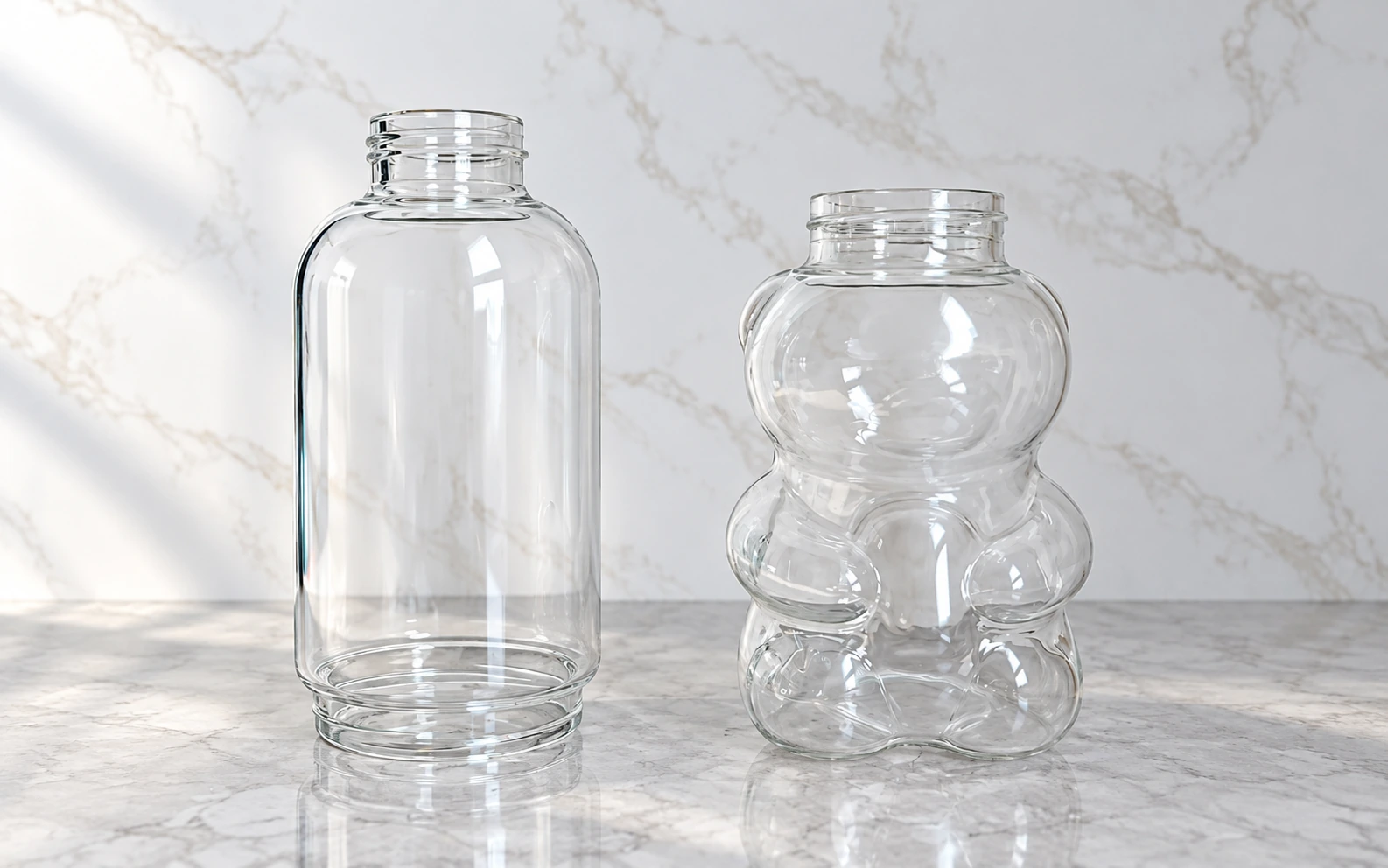
A glass component can look right and still fail to fit the product it was designed for. A threaded end may engage with its matching part, while an uneven rim prevents the assembly from sitting correctly. For product developers and procurement teams, appearance and assembly performance need separate checks.
Custom borosilicate glass components are made to meet the requirements of a larger assembly rather than simply provide a standard container. For open-ended bodies used with caps, filters or housings, the drawing needs to define both the glass geometry and its connections.
At MC Glass, we work on custom borosilicate glass parts made to customer drawings and samples. This guide explains what to confirm when sourcing threaded glass bodies, from the initial design review to sample approval and repeat orders. A related bear-shaped drinkware example illustrates our custom mould development capability beyond straight-sided parts.
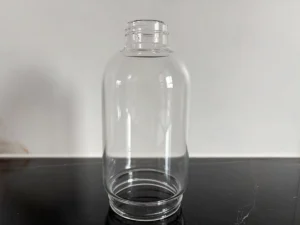
What Are Double-Ended Threaded Glass Bodies?
A double-ended threaded glass body is open at both ends and has connection features that allow separate parts to be attached. Unlike a conventional jar, the glass body alone is not a complete storage container. Its function depends on the components fitted to it.
A straight-sided glass cylinder provides a simple body profile. A fluted borosilicate glass body has longitudinal grooves or ribs, which also need to be defined on the drawing. A shaped body may include a shoulder, flange or reduced-diameter connection.
The two ends do not necessarily have identical threads. Specify them separately, including their relationship to the body axis. Also, double-ended does not mean double-walled: two openings describe the ends, while two walls describe a different construction.
Why Specify Borosilicate Glass?
Low thermal expansion and chemical durability are important reasons for considering borosilicate glass. Published information for established grades, such as SCHOTT DURAN, describes these properties. The material used for your project must nevertheless be specified and documented separately.
Start with the material designation, dimensions and intended use rather than a general request for “heat-resistant glass.” Do not assume that a data sheet for one branded glass applies to a different material.
Material selection is only one part of the design. Sudden temperature changes, surface damage and inappropriate mechanical loading can still cause glass to fail. A material temperature rating alone does not establish suitability for direct-flame heating, pressure service or a complete appliance.
Potential Applications in Drinkware and Appliances
Borosilicate glass and separate stainless steel parts are already combined in commercial tea-infuser products. However, the connection, seal and supporting structure differ between designs.
For a removable-base drinkware project, define how the upper cap and lower closure attach, where sealing occurs and which parts the user removes for cleaning. The quotation should distinguish the glass body from the complete bottle.
For a tea or filtration assembly, identify how the glass part is supported and how it connects to the filter or surrounding housing. A locating flange, a threaded joint and a liquid seal are different functions and should not be treated as interchangeable.
For appliance or replacement components, provide the equipment drawing and operating conditions. A glass vessel supplied alongside a blender is not automatically suitable for contact with a rotating blade. Compatibility must be assessed for the specific assembly, not inferred from appearance.
Dimensions That Matter for Assembly
When sourcing custom threaded glass tubes, a nominal diameter is not enough. We recommend identifying the dimensions that affect assembly first, then agreeing feasible tolerances and inspection methods before tooling begins.
| Feature to Specify | What to Clarify on the Drawing |
|---|---|
| Overall height | Finished height and tolerance, measured between clearly identified reference surfaces. |
| Outer and inner diameters | Measurement positions along the body, including shoulders and connection areas. |
| Wall thickness | Target thickness and acceptable variation at the locations relevant to the design. |
| Thread and engagement geometry | Thread profile, pitch or lead, number of starts, direction, engagement length and any stops or lugs. |
| Roundness and alignment | Permitted out-of-roundness and the alignment of both interfaces with the body axis. |
| Rim geometry | Rim flatness, edge profile and its orientation relative to the assembly seating surface. |
| Seating and sealing areas | Where loads and seals act, required contact areas and mating-part clearances. |
Mark the truly critical dimensions rather than applying the tightest tolerance to every surface. A decorative profile may allow more variation than a locating diameter or a sealing surface.
Treat the mating component as part of the specification. Send its drawing and, where possible, physical samples. A successful fit with one handmade sample is a useful starting point, but it does not establish interchangeability across production batches.
Agree the required clearance and assembly force with the product engineer. Do not use extra tightening force to compensate for a dimensional mismatch.
Prototype Development and Fit Validation
A useful sample programme separates dimensional checks, assembly checks and intended-use testing. MC Glass’s broader research and development support follows a sequence of specification review, tooling planning, sampling and approval. For a custom component, the exact route should be agreed around its geometry and function.
Review the Drawing Before Making Tooling
Provide the current 2D drawing and a 3D STEP file where available. Identify the revision, units, material and matching parts. A physical sample can clarify appearance and fit, but the approved drawing should state which dimensions control acceptance.
For tube-based parts, review the starting tube size, forming requirements, end finishing and any dedicated fixtures. Confirm which tooling is needed for samples and whether it is intended for subsequent production.
Check the Finished Glass Part and the Complete Assembly
Measure the glass part after all relevant finishing operations. Compare height, diameters, rim geometry and connection features with the approved drawing. Inspect for chips, cracks and other agreed visual defects before attempting assembly.
Then check the component with its intended cap, metal part or housing. Review engagement, seating, alignment, removal and reassembly. Where sealing is required, include the specified seal and an agreed leak-test procedure. A thread that engages is not, by itself, proof of a leak-tight joint.
Resolve Deviations Before Approving Repeat Production
Record dimensional and functional issues separately. A part may engage correctly while its rim appearance needs improvement; another may look correct but fail to seat. After a fixture or forming adjustment, recheck both the corrected feature and the interfaces that must remain unchanged.
Sample acceptance should identify the approved drawing revision, inspection criteria and retained reference samples. This gives future orders a defined basis for comparison rather than relying on an informal instruction to “make it like last time.”
Agree Testing for the Actual Use
Define the required heating and cooling conditions, cleaning method and repeated assembly cycles. Include pressure, vibration or blade-related requirements only where relevant to the product. These are items for a project-specific validation plan, not performance claims for every borosilicate component.
Our quality control overview describes general inspection support. Acceptance checks and any external laboratory testing for your component should be confirmed separately.
Related Customisation Example: A Bear-Shaped Borosilicate Glass Bottle
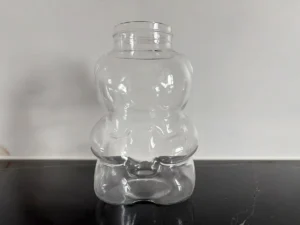
Beyond double-ended glass bodies, MC Glass also develops custom-shaped borosilicate drinkware. The bear-shaped bottle body illustrates our mould-based customisation capability, combining a sculpted exterior with a threaded opening.
This is a separate drinkware example rather than a double-ended assembly component. It demonstrates how a glass product can be developed around a distinctive external form instead of a standard cylindrical profile.
For a project like this, the design review should cover the body contours, intended capacity, wall thickness distribution, rim finish and base stability. Where a lid is required, the opening and thread dimensions also need to be agreed with the matching closure. Appearance and functional requirements should both be checked during sampling.
Brands developing their own drinkware designs can send us drawings or reference samples, target capacity, lid requirements and expected order quantities. We can then review the proposed design and discuss a suitable tooling and sampling approach before production.
Decoration and Food-Contact Requirements
Logos, measurement marks and instructions may need to be added to the glass body. MC Glass offers glass decoration options including screen printing, decals and frosting. The suitable process for a borosilicate part depends on its geometry, access to the print area and service conditions.
Keep artwork separate from the dimensional drawing, but link both to the same project revision. Identify surfaces that must remain free of decoration, especially where another part seats or a seal makes contact. Define any wash-resistance or abrasion requirements before sampling the decoration.
For food-contact applications, identify the destination market, food type, contact time, temperature and whether the article is reused. EU food-contact rules concern the safety of materials and articles under their intended conditions of use. A generic material description does not replace an assessment of the finished component.
Ask which documents apply to the actual glass and decoration being supplied. Where printing is present, include the decorated sample in the agreed evaluation rather than testing only an undecorated part.
What to Include in Your RFQ
A complete request for quotation helps a borosilicate glass components manufacturer distinguish a simple forming job from an assembly-development project. We recommend sending the following information together.
| RFQ Information | Details to Provide |
|---|---|
| Application and supply scope | What the glass connects to, how it is used, and whether you need glass only or additional parts. |
| Drawings and samples | Current 2D drawing, 3D STEP file if available, reference photos and mating-part information. |
| Material and finish | Required glass grade, transparency, surface texture, colour and decoration. |
| Quantity and schedule | Sample quantity, first production order, expected repeat orders and target delivery date. |
| Acceptance requirements | Critical dimensions, fit criteria, appearance limits and relevant testing requirements. |
| Commercial and logistics details | Destination, packing requirements, delivery terms and tooling ownership or exclusivity requirements. |
Ask for tooling, sampling, decoration setup, unit pricing, testing and freight to be itemised where applicable. Clarify what each charge covers. An existing forming fixture, a new mould and a printing setup are not necessarily the same cost item.
Separate sample-development time from production lead time and transit time. For repeat orders, discuss the expected call-off schedule instead of assuming that a monthly quantity automatically means a one-month delivery cycle.
Frequently Asked Questions
Can You Develop a Glass Component from a Sample?
MC Glass can review a physical sample as the starting point for a custom project. The next step is to confirm the dimensions, material, mating parts and acceptance criteria in a drawing. A worn or damaged sample should not be treated as an exact dimensional standard.
Can Both Ends of a Glass Body Have Custom Connections?
Both ends can be included in the design review, with different interfaces where required. Feasibility depends on the geometry and manufacturing route. Specify each end separately and provide the components that need to connect to it.
Can You Develop a Custom-Shaped Borosilicate Glass Cup?
Yes. MC Glass can review customer designs and develop moulds for custom-shaped borosilicate drinkware, including bodies with threaded openings. The proposed form, capacity, lid requirements and manufacturing feasibility need to be reviewed before tooling and sampling.
What Are the MOQ and Tooling Cost?
MOQ and tooling cost are quoted after reviewing the design, material, manufacturing requirements and order plan. A minimum quantity quoted for a conventional glass bottle should not be assumed to apply to a custom borosilicate component.
Does a Successful Fit Test Mean the Component Is Ready for Production?
Not on its own. Fit is one approval item. The release decision should also cover dimensional consistency, appearance, any decoration, relevant use testing and packing. Record outstanding items before authorising the next stage.
Request a Custom Glass Component Review
Developing a threaded glass body for drinkware, a filtration assembly or another OEM product? Or planning custom-shaped borosilicate drinkware? Contact MC Glass with your drawing or reference sample, mating-part details where applicable, and expected order quantities.
We can review the proposed structure and discuss the next steps for feasibility, tooling and sampling. For new designs, please identify the current development stage and any confidentiality requirements before sharing technical files.
The goal is not simply a glass sample that looks right, but a component with an agreed specification for fit, finish and repeat orders.