

Choosing the right glass honey jar is about more than finding an attractive container. For honey producers and packaging buyers, jar capacity, shape, lid compatibility, labeling, and filling requirements all influence the final packaging decision.
Should you choose a classic round honey jar or a distinctive hexagonal design? What size jar do you need for 250g of honey? Is a 25ml mini jar suitable for your product range? And how do you select the correct metal lid?
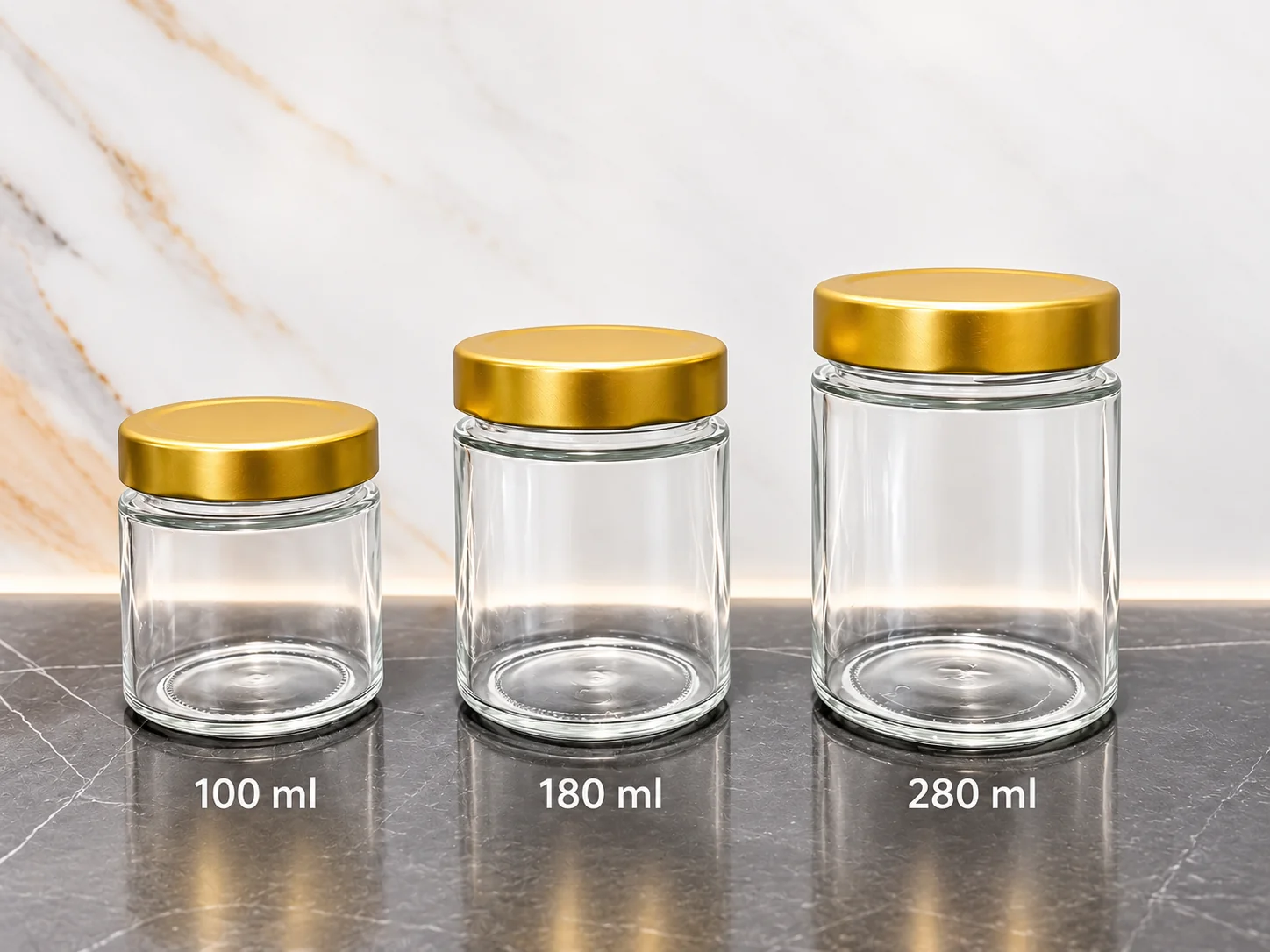
In this guide, MC Glass shares practical considerations based on real honey jar packaging projects, including 25ml mini jars and coordinated 100ml, 180ml, and 280ml glass jar collections.
1. Honey Jar Sizes: Understanding Milliliters and Grams
One of the most common questions when selecting honey jars is how to match the required honey weight with the right glass container.
Glass jar capacity is normally expressed in milliliters (ml), while packaged honey is commonly sold by net weight in grams (g) or ounces (oz).
These measurements are not interchangeable.
Honey is denser than water. Depending on its moisture content and temperature, honey typically has a density of approximately 1.4–1.44g/ml. For preliminary packaging calculations, 1.42g/ml is a useful reference.
The approximate volume required can be calculated as:
Honey Volume (ml) = Honey Net Weight (g) ÷ Honey Density (g/ml)
For example:
- 100g of honey requires approximately 70ml of liquid volume.
- 250g of honey requires approximately 176ml.
- 400g of honey requires approximately 282ml.
- 500g of honey requires approximately 352ml.
These figures represent the volume occupied by the honey, not the final jar size that should be ordered.
A jar needs sufficient usable filling volume, and the appropriate headspace must be considered. The manufacturer’s nominal capacity may also differ from the brimful capacity.
For example, a nominal 180ml honey jar may appear suitable for 250g of honey based on a simple calculation. However, this does not guarantee sufficient filling space. Similarly, a 280ml jar should not automatically be selected for a 400g honey pack, since the estimated honey volume already exceeds 280ml before allowing for headspace.
Always test the actual honey fill weight, filling level, and closure fit before confirming a bulk order.
Common Glass Honey Jar Sizes
| Jar Capacity | Typical Packaging Application |
|---|---|
| 25ml | Miniature honey packs, tasting samples, gift sets |
| 100ml | Small retail packs, specialty honey collections |
| 180ml | Compact retail packaging and gift assortments |
| 280ml | Medium-sized retail honey packaging |
| 380ml–500ml | Larger retail and regular-use honey packs |
| 730ml and above | Family-size packs and larger honey products |
The best size depends on your target net weight, product density, bottle dimensions, and filling requirements.
2. Choosing a Coordinated Range of 100ml, 180ml and 280ml Honey Jars
Many honey brands want to offer several pack sizes without changing their overall packaging identity.
One practical solution is to select a family of glass jars with a similar shape, consistent proportions, and matching lid finishes.
For example, MC Glass offers a range of round glass jars in 100ml, 180ml, and 280ml sizes, with gold-colored metal lids.
This type of coordinated collection allows a honey brand to develop different package sizes while maintaining a recognizable appearance across the range.
180ml Round Glass Honey Jar
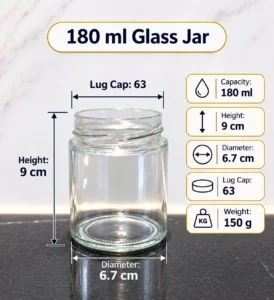
The 180ml jar is a compact cylindrical design with a clear glass body and a metal lug cap.
Its reference specifications are:
| Specification | Value |
|---|---|
| Nominal Capacity | 180ml |
| Height | 9cm |
| Diameter | 6.7cm |
| Glass Jar Weight | 150g |
| Lid | 63mm Lug Cap |
The straight-sided shape provides a useful surface for labels, while the clear glass allows customers to see the honey inside.
280ml Round Glass Honey Jar
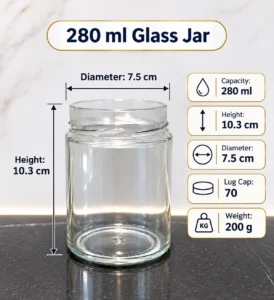
The 280ml version follows a similar design but offers a larger container.
| Specification | Value |
|---|---|
| Nominal Capacity | 280ml |
| Height | 10.3cm |
| Diameter | 7.5cm |
| Glass Jar Weight | 200g |
| Lid | 70mm Lug Cap |
These two jars can be used to develop a consistent product range, with different label designs or lid colors to distinguish honey varieties.
However, the 180ml and 280ml jars use different lid sizes. The correct cap must be selected for each jar rather than assuming the same closure will fit the entire series.
For brands requiring additional capacities, MC Glass also supplies round glass honey jars in other sizes.
3. Round vs. Hexagonal Honey Jars: Which Is Better?
Round and hexagonal glass jars are two popular options for honey packaging. Each offers different advantages in product presentation, labeling, and production.
Round Glass Honey Jars
Round honey jars have a classic appearance and are widely used for retail honey packaging.
Their main advantages include a familiar shape, a continuous curved labeling surface, and straightforward handling on many conventional filling and labeling systems.
Round jars are particularly suitable for brands that want several capacities with a consistent appearance.
For businesses using automatic labeling equipment, cylindrical containers may also be easier to handle with standard wrap-around labeling systems.
Hexagonal Glass Honey Jars
Hexagonal honey jars have six sides, creating a distinctive geometric appearance.
Their flat faces can provide useful areas for labels, making them attractive for specialty honey, premium collections, and gift packaging.
A single label can often be placed on one flat face, depending on its dimensions and the jar design.
However, hexagonal jars may require additional attention during automated labeling.
Traditional round-bottle labeling machines rely on continuous rotation. A hexagonal container does not rotate in the same manner as a cylindrical bottle, which can affect label placement and alignment.
For some production lines, a semi-automatic single-side labeling machine or a suitable positioning fixture may be a more practical solution.
How Should You Choose?
If efficient labeling and a coordinated range of sizes are your main priorities, round glass jars are often a convenient starting point.
If distinctive packaging and flat label panels are more important, hexagonal jars may be a better choice.
For both designs, check the filling equipment, cap compatibility, label dimensions, and outer packaging before placing a large order.
You can also explore our hexagonal glass honey jar designs for additional packaging options.
4. Mini Honey Jars: Why 25ml Packaging Matters
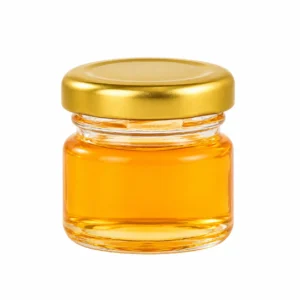
Small glass honey jars serve a different purpose from regular retail packs.
A 25ml mini glass jar is particularly useful when the goal is to present a small amount of honey in an attractive, compact package.
Potential applications include:
- Honey tasting and promotional samples
- Gift boxes containing several honey varieties
- Wedding favors and event gifts
- Hotel breakfast portions
- Specialty honey collections
MC Glass has also supplied 25ml mini glass jars for repeat wholesale orders, demonstrating the practical demand for this small packaging format.
What Should Buyers Consider for 25ml Jars?
With such a small container, label design becomes especially important.
A large label may cover much of the glass surface and make the product look crowded. A smaller front label or a label on the lid may be more appropriate.
The lid must also be easy to open and properly matched to the jar finish.
For commercial orders, buyers should pay attention to the jar’s actual filling capacity, cap diameter, packing quantity per carton, and transportation protection.
Although miniature jars use less glass per unit, their small size does not automatically mean a lower total packaging cost. Lid costs, handling, labeling, and packing requirements must also be considered.
5. Choosing the Right Lid for Glass Honey Jars
The lid is not just a decorative part of honey packaging. It is essential for sealing the product and protecting it during storage and transportation.
Metal Lug Caps and Twist-Off Closures
Many glass honey jars use metal lug caps, commonly referred to as twist-off lids.
A lug cap engages with the matching finish on the glass jar and uses a suitable sealing liner to create the required seal.
For example, our round honey jar range includes:
- 180ml glass jar with a 63mm lug cap
- 280ml glass jar with a 70mm lug cap
The closure size and finish must match the actual jar design. A nominal cap diameter alone does not establish compatibility.
A continuous-thread screw cap and a lug-style twist-off cap are also different closure systems and should not be treated as interchangeable.
Choosing Lid Colors
Gold, black, and other available lid colors can create different packaging styles.
Gold lids offer a traditional presentation, while black lids can produce a simpler, more contemporary appearance.
Before choosing a lid, confirm its sealing liner, food-contact suitability, opening performance, and compatibility with your filling method.
If your honey is filled warm or undergoes a specific processing method, the jar and closure should be evaluated under the actual processing conditions.
For a broader explanation of closure options, read our Glass Bottle Caps and Closures Guide.
6. Honey Jar Labels and Custom Branding
Choosing a glass jar also means considering how the finished product will look on the shelf.
Two jars with identical capacities can create very different impressions depending on their shape, lid color, and label design.
Labeling Round Honey Jars
Round jars provide a continuous curved surface for wrap-around labels.
Before printing labels, confirm the usable labeling height, circumference, and any changes in the bottle profile.
Labels should not extend into curved shoulder areas or other surfaces that may prevent consistent adhesion.
Labeling Hexagonal Honey Jars
For hexagonal jars, the width of each flat face is an important design consideration.
A label that fits one flat panel may look cleaner than an oversized label extending across several corners.
If using a mechanical labeling system, confirm whether the jar needs to be positioned before label application.
Custom Decoration Options
Depending on the jar design and production requirements, branding options may include:
- Custom adhesive labels
- Screen printing
- Multicolor decal printing
- Color coating
- Frosted glass finishes
- Embossed logos on custom-molded jars
For smaller jars, simple labels or lid customization may offer a practical solution. For larger projects, custom decoration or a new glass mold may help establish a distinctive packaging identity.
Before proceeding with decoration, confirm the printable area, artwork dimensions, order quantity, and production feasibility.
7. What Should Honey Producers Check Before Ordering Jars in Bulk?
Before purchasing wholesale glass honey jars, it is helpful to evaluate the complete packaging system rather than the empty jar alone.
Confirm the Honey Net Weight
Start with the intended weight printed on the finished product label, then calculate the approximate filling volume.
Allow for the required filling level and perform a test using the actual honey.
Check Jar Dimensions and Weight
Ask for the jar height, diameter, empty glass weight, and usable filling capacity.
These details affect not only presentation but also carton dimensions, pallet loading, and shipping costs.
Confirm the Lid and Sealing System
Check the neck finish, lid size, sealing liner, and filling method.
Request matching jar and lid samples for compatibility testing before placing a large order.
Evaluate Labeling and Decoration
Make sure your artwork fits the chosen jar.
If you use automatic equipment, test the bottle with your labeling line before finalizing the design.
Review Minimum Order Quantities
Existing molds may offer a more economical starting point than a completely new design.
However, minimum order quantities vary by jar model, available inventory, lid type, and decoration requirements.
Request Samples Before Production
Samples are especially important when developing a coordinated family of different jar sizes.
Check each capacity individually, including the jar, cap, label, and filled product.
A sample approval process can help reduce problems during larger production runs.
8. Frequently Asked Questions About Glass Honey Jars
What size glass jar should I use for 250g of honey?
At an estimated density of 1.42g/ml, 250g of honey occupies approximately 176ml. A nominal 180ml jar may not provide enough usable filling space and headspace. Confirm the actual jar capacity and conduct a filling test before selecting the final size.
Can I use a 280ml glass jar for 400g of honey?
Do not assume so. At the same reference density, 400g of honey occupies approximately 282ml before headspace. A jar with a true capacity of only 280ml would be insufficient. A larger jar may be required.
Are round or hexagonal jars better for honey?
Both are suitable options. Round jars are convenient for many standard labeling systems, while hexagonal jars offer distinctive flat surfaces for branding. The best choice depends on your packaging design and filling equipment.
Can I order several honey jar sizes with matching lids?
You can develop a coordinated range with similar lid colors and finishes, but different jar capacities may require different lid diameters. Closure compatibility must be confirmed for each jar.
Can I customize the jar shape or label?
Yes. MC Glass supplies existing glass jar designs and supports custom packaging projects. Available options depend on the selected jar, decoration requirements, and order quantity.
Find the Right Glass Honey Jars for Your Brand
Whether you need 25ml mini honey jars, a coordinated range of 100ml, 180ml and 280ml containers, or larger glass jars for retail honey packaging, choosing the right size and closure is the first step.
MC Glass supplies wholesale glass honey jars from existing designs and supports custom packaging development for honey brands, importers, and distributors.
Browse our Wholesale Glass Honey Jar Collection to explore available shapes and sizes.
For a quotation, please Contact MC Glass with your target honey net weight, preferred jar capacity, shape, lid type, labeling requirements, estimated order quantity, and delivery destination.
We can help you compare available jar designs and discuss suitable packaging options for your project.
Pingback: Best selling glass bottle from the collection to follow the market trends | MC Glass